
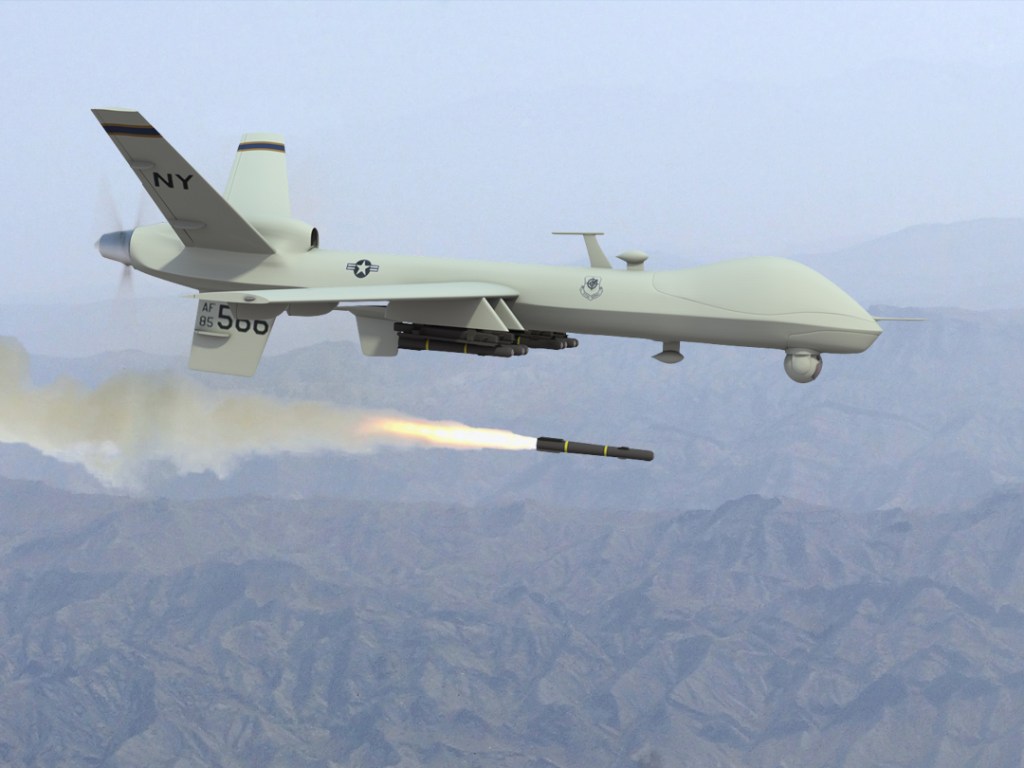
Disclaimer: Because I can only write with some measure of authority from the perspective of ethics and critical reasoning – my background is in philosophy generally and ethics in particular – I am setting aside issues related to national and international law. Whether or not law allows for drone killing is another issue worth investigating – and one that many legal scholars have tackled, but is not a question I address in the scope of this article.
Edit: See comments/responses below this post for an expansion of this post with regard to unintentional collateral damage (i.e. the killing of innocent bystanders), which is something I mean to write on when I began this post but forgot as I passed the 2k-word mark. I thank the commenter for prompting me to clarify my position on this relevant aspect of the topic.
—-
In this post, I’ll defend the notion that it’s morally obligatory to use unmanned aerial vehicles (UAVs) to kill people engaged in acts of terrorism. First, I’ll give some moral background to the notion that all people are deserving of respect. That being the case, it’s always wrong to kill. Second, I’ll offer a toy example in which I tease out a moral principle about justified killing. Third, I’ll discuss some complications that arise as a product of the example. Then, I’ll draw some conclusions about what all of the aforementioned means for UAV attacks on those engaged in acts of terrorism.
One assumption common to modern (say, from the time of John Locke) ethics is that all people, in virtue of their humanity, are due a certain kind of respect. What “respect” amounts to is an issue philosophers have been addressing for the last 100+ years, and I don’t expect to solve it today. Usually, though, to treat someone with respect means to treat them as important by taking their ends (goals) to be valuable for oneself. So, if I respect you but disagree with your pursuit of a degree in philosophy, I should treat your goal as valuable to me – and encourage you as if it were my goal that you earn a philosophy degree. Usually, too, respect means not treating people badly – generally put. It means refraining from killing, torturing, enslaving, or otherwise abusing someone. I ought not to set aside your humanity in pursuit of my own ends. If I disagree with your lifestyle, I should not pass a law that prevents you from pursuing the life you wish to lead, unless your doing so would be radically disrespectful toward other people (if, for instance, your ‘lifestyle choice’ is to be a serial murderer). This is an admittedly vague and broad definition of respect, but it will have to do in this context.
Respect usually is a zero-sum game when it regards extreme instances of potential disrespect. For instance, our moral duty to respect others clearly requires us not to kill them to satisfy our own personal aims. I cannot both respect you and murder you. For this reason, any form of murder necessarily is disrespectful, and therefore immoral. This is a commitment I endorse without regard to the consequences of any particular instance of killing.
Often, in the public forum, ‘murder’ is defined to suit the argument: Capital punishment is not murder, the argument in favor of the practice might claim; killing in self-defense is not murder, and so on. Murder is often defined as “unjustified killing.” So, if Y is justified in killing Z, Y has not committed murder and so is not morally blameworthy for committing the act of murder. (Y may be blameworthy for other reasons, but not for committing a murder).
Here is where things get particularly tricky. Often, a society seems to want to define a particular instance (or group of instances) so as to exclude it from the category of murder and include it in the category of justified killing. The purpose of this exclusion is to render a particular instance of killing morally acceptable.
I don’t buy this argument. It seems to me that justified killing is still killing, and, if we value a person’s humanity, ending that person’s life (against the wishes of that person) is murder, and is always morally abhorrent. This line of thought does not preclude a particular murder from being justified, however. As we will see, there are some clear cases in which a particular case of killing can be both wrong and justified.
That said, something can be both morally wrong and still be the right thing to do. That is, what is right can be so in virtue of the fact that it is the least-wrong outcome in a given case. To take an example of a simpler case than that which I’ll be consider in this post, imagine the following scenario:
Tom and Jerry live in the same house. Tom is a cat and Jerry is a mouse. (I think you know this story). Let’s imagine that cats and mice are due the same sort of respect that humans are due. Tom tries, day in and day out, to kill Jerry. He does it because it is a kind of carnal desire for him. It’s his natural inclination – and he feels compelled to kill Jerry, for one reason or another. Let’s assume that Tom doesn’t need to kill Jerry for food – Tom is fed by his guardian, a human who we don’t need to know about apart from the fact that he provides sustenance to Tom. So Tom doesn’t need to kill Jerry – he just wants to, albeit for what might be described as physiological reasons. Tom’s killing Jerry would be morally abhorrent. Tom’s refraining from killing Jerry would be morally good – but he won’t refrain. He’s made it clear that he’ll keep trying until he’s successful. He doesn’t ask his owner for help to stop him attempting to kill Jerry (in the form of what philosophers sometimes call a “pre-commitment device”).
Imagine that an all-knowing, all-powerful philosopher has the power to end Tom’s life (against Tom’s wishes) and spare Jerry an undesired end to his own. It would be wrong for the philosopher to do this, but it would be more wrong to allow Tom to continue in his efforts to kill Jerry. Because Tom could, however unlikely his physiological urges make this course of action, refrain from killing Jerry. Tom has not given up his cat-hood, in virtue of which he is due respect equal to that due to Jerry (and all people). So, if the philosopher kills Tom, he treats Tom disrespectfully, and so commits a moral wrong. However, if the philosopher wants to do what is most right under these circumstances, he must kill Tom.
My claim here is that killing Tom is better than allowing Tom to kill Jerry, given that we know Tom is working doggedly toward that end. Killing Tom is wrong, but it’s less wrong than killing Tom for arbitrary reasons when, given this option, by killing Tom we can prevent him from killing Jerry.
I’ve chosen this toy example for its clear manifestation of the claim I’m supporting in this article: That using drone strikes to kill what are reasonably termed “enemy combatants” and their familiars is wrong, but is less wrong than allowing those people to carry out their plans to destabilize governments, kill civilians, and generally cause worldwide pandemonium. My argument for this point of view is consequentialist in its method, but also accepts the non-consequentialist foundational assumption that killing is always wrong. I do accept the idea that killing someone can be justified, but that does not make it morally acceptable.
The phrase – “for the greater good” – has led to many abuses and to the tyrannical treatment of millions of people over the course of just the last century (setting aside the countless millions more who suffered under the misuse of this aim over the course of history altogether). However, that does not mean that a truly greater good does not exist. Killing someone is worth a great deal, but saving many lives is worth a great deal more. This calls to question the obvious query: How many lives must be saved to justify ending one life?
Before I answer this question, consider a major problem with the Tom and Jerry example from above. One of the (several) problems with my Tom and Jerry example is that the fictional case exists in a vacuum (moral and otherwise). For instance, if it were possible for a person to be all-knowing, then the example would have wider instructional value. However, this is not possible. We all are limited in what we can know, even if we have reports, briefings, etc. at our fingertips. So our decision, were any of us in charge of making such a call, is quite unlike that which is made by the philosopher in the example. Another effect of the idealized example is that it takes out of consideration the societal social and psychological consequences of a hand-from-above striking down an aggressor. In truth, if the government were to have this power over its citizenry, the other citizens would not be able to live normal, self-determined lives. They would live in terror that they, perhaps, would be next to be smitten, in order to serve what might be called the greater good. The consequences would be extreme, and so the greater good almost never would be served by the government’s choosing to end this or that particular individual’s life. The problem is that our government does have this power, despite the fact that it lacks the ability to calculate reliably the cases in which use of the power is justified.
So, while the Tom and Jerry example sets forth a principle about justified killing in the name of the truly greater good, it is likely that the conditions satisfying the principle will almost never obtain in the real world. The risk of causing unacceptable consequences for our global society is immense.
Remember that, above, I set aside the question, “How many lives must be saved to justify ending one person’s life?
It seems that this is a question we can set aside quite reasonably if we establish as a baseline that terrorism, on the whole, does not cost lives alone. If those who engage in acts of terror were to be protected from targeting by drones or other military actions, the consequences would be dire for nations (plural), for global economic security, for global peace (between nations), and for global stability more generally. These consequences may sound extreme, but I am likely here to be wildly understating the costs of unchecked global terrorism.
So, when the question (“How many lives…?”) involves terrorism, the answer is that the question does not find application. If a government recognized by the other governments on earth and by the society that enacts that government has the ability to stop terrorism by engaging in warfare (e.g. by killing those involved with terrorism), the consequences under consideration include not lives – but entire civilizations. Protecting modern civilization, no doubt, is a greater good worth serving.
Furthermore, if an agent’s specified ends include destabilizing governments, societies, and undermining the peace of mind of the rest of humanity (those who do not share that agent’s aims), that agent’s aims ought not to be considered as valuable. It is legitimate not to value the aims of an agent who aims to terrorize other members of humanity. Stopping that person from realizing his aims is part of what is required to treat the rest of humanity – those he aims to terrorize – with respect. Our obligation to treat with respect members of humanity whose aims include radical disrespect of other members of humanity is diminished.
There’s some concern about the technical superiority of UAVs, perhaps setting drone strikes apart from traditional methods of warfare. In a 2010 article, Thomas J. Billitteri wrote the following:
Drone technology itself is astonishing in its capacity to reconnoiter and kill. In the case of the Predator and its even more powerful brother, the Reaper, controllers sit at computer consoles at U.S. bases thousands of miles from harm’s way and control the aircraft via satellite communication. With the ability to remain aloft for long hours undetected on the ground — Predators can fly at altitudes of about 50,000 feet — the planes can do everything from snap high-resolution reconnaissance photos of insurgents’ vehicles to shoot Hellfire missiles at them.
A secret archive of classified military documents controversially released in July [2010] by the group WikiLeaks revealed the lethal power of the Predator. As reported by The New York Times, in early winter 2008 a Predator spotted a group of insurgents suspected of planting roadside bombs near an American military outpost in Afghanistan. “Within minutes after identifying the militants, the Predator unleashed a Hellfire missile, all but evaporating one of the figures digging in the dark,” The Times said. “When ground troops reached the crater caused by the missile, costing $60,000, all that was left was a shovel and a crowbar.”
In 2011, an Illinois Law Review article tells a similar story:
Drones represent a summit in long-distance killing. From the Neolithic spear, to the bow and arrow, to artillery, to the airplane, to the cruise missile, advances in weaponry over the millennia have made it easier and safer to kill from great distances. Drones, combined with suitable missiles, have taken this process to its logical extreme.
Though the point I’m about to make was not the focus of these articles, consider the following. Characterizing unmanned warfare in this fashion often is used to distinguish modern forms of warfare from older forms of warfare. The purpose of this distinction generally is to support an argument that we ought to employ a different class of moral expectations on the new kind of warfare. The point usually is: “Look how easy it is to take a human life – this is not like the usual methods of conducting a war.”
Sometimes, the only feasible means of stopping that person is to use a drone to kill that person. These circumstances obtain when using other means of stopping that person would put many other lives at risk. The risk to the actors engaged in the type of targeted killing in which drones engage is substantial – and, if it can be avoided, it ought to be. Those actors’ aims and lives are worth saving, as it is their goal to prevent terrorists from committing acts of atrocity. Therefore, the use of drones instead of direct human action is not only acceptable; it is obligatory, where it is an option. The fact that it is easier, broadly speaking, than sending human combatants to accomplish the same task, counts for the practice and not against it.
All that established: If an authorized agent of a government can establish to a sufficiently high level of certainty that a person has the intent and the means to commit acts of terrorism, and one has the option of killing that person, the agent ought to do so. As Radsan and Murphy argue in their article, the burden of establishing a sufficiently high level of certainty should be a high bar to clear. We have not yet reached a determination regarding this sufficiency criterion.
That said, If this agent of the government has the ability to take the life of someone who reasonably can be expected to engage in acts of terror by use of UAVs, and in so doing can spare calamity to other members of humanity, it has a moral obligation to do so. It is wrong to kill – even to kill those engaged in acts of terrorism – but it is less wrong to kill in these cases than it would be to refrain from killing.
—-
Resources:
[Edit: A few days after I published this post, Justin Caouette (of Univ. of Calgary) directed me to an article in The Guardian from Thursday Aug 2nd 2012 depicting Bradley Strawser’s view, which is strikingly similar to my own. You can also read Strawser’s self-penned article in The Guardian from August 6th 2012.
Bradley Jay Strawser (2010): Moral Predators: The Duty to Employ Uninhabited Aerial Vehicles, Journal of Military Ethics, 9:4, 342-368]
Thomas J. Billitteri, “Drone Warfare: Are Strikes by Unmanned Aircraft Ethical?” The CQ Researcher 20.28 (2010): 653-676.
Afsheen John Radsan and Richard Murphy, “Measure Twice, Shoot Once: Higher Care for CIA-Targeted Killing” University of Illinois Law Review 2011.4 (2011): 1201-1241.
Joanne K. Lekea “Missile Strike Carried Out with Yemeni Cooperation — The War Against Terrorist: A Different Kind of War?” Journal of Military Ethics Vol. 2, Issue 3 (2003): 230-239.
See also – a recent blogger taking on the ethical issues: http://dronewarsuk.wordpress.com/2012/08/19/reflecting-on-the-recent-rash-of-writing-on-morality-and-drones/
 Whisper House Press
Leave a comment