
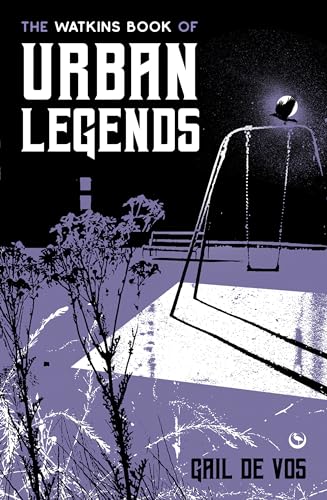
Book: The Watkins Book of Urban Legends
Author: Gail de Vos
Publisher: Watkins Publishing
ISBN: 9781786788559
Expected Publication: 12 November 2024
Capone’s Rating: 3 of 5⭐
You may see three of five stars and may assume I’m trying to discourage readers from picking up this volume. I am not. It’s a good book, but it has some glaring flaws that do it a disservice. But ignoring the book would be a disservice to you as a collector of modern myths and legends or as a horror reader or writer aiming to broaden your knowledge base. Folks in any of these situations would do themselves a favor by reading The Watkins Book of Urban Legends.
In this manuscript, Gail de Vos has grouped urban legends, myths, and false beliefs into broad categories (e.g. haunted places, common medical misconceptions, specific haunts not tied to particular places, etc.). The collection is pretty large—are there eighty stories in here? A hundred? A lot, in any case.
Some challenging aspects of de Vos’s approach will challenge any curious reader: is the author offering her best attempt at a true accounting of a rumor? or a true accounting of the common accounting of that rumor? Is the author trying to help us choose correctly morally in retelling others’ tales? Is she trying to correct common misconceptions of popular beliefs? The trouble is, there’s no particular focus here, and it’s sometimes tough to distinguish what thing among these the author is doing in a given section. Is the author offering us what she believes is the true story behind a tale folks have been retelling for ages—its origin? Or is she merely reporting one frequently told variant of the story? It’s a challenge to distinguish what goal is being served by which section of text, and sometimes it seems to flip from one purpose to another from one brief tale to the next.
I’m reading an advanced reader copy of this text, and I really hope the editors get it together with the typos, missing words, and poorly phrased sentences. If they let it fly as is, the author—who by and large does an excellent job with this sort of thing—will be badly represented. While dreaming of things I wish were true, I also believe the book would be much better if written by one more accustomed to writing stories as opposed to telling them aloud to audiences in face-to-face scenarios. The word choices, pacing of telling, and written story construction generally is problematic throughout the volume. A writer focused more on craft would provide—well, a better written telling of those tales.
Another odd choice that I hope the publishers catch in a new phase of developmental editing is the decision to include medical misconstruals and myths. Including the section highlights people’s mistaken beliefs about medical practices and pharmacological truths, thereby stretching the notion of popular legends to the point of meaninglessness—any common confusion at all would qualify for inclusion in this volume, if this working definition holds. This section really ought to be dropped from the text in revision.
These challenges aside, I’m glad the author has chosen to collect these stories and offers them to the public domain for retooling and retelling, and I’m glad the publisher is releasing this collection. A lot of us out there in storyland would do well to read it.
Three stars.

 Whisper House Press
Leave a comment