
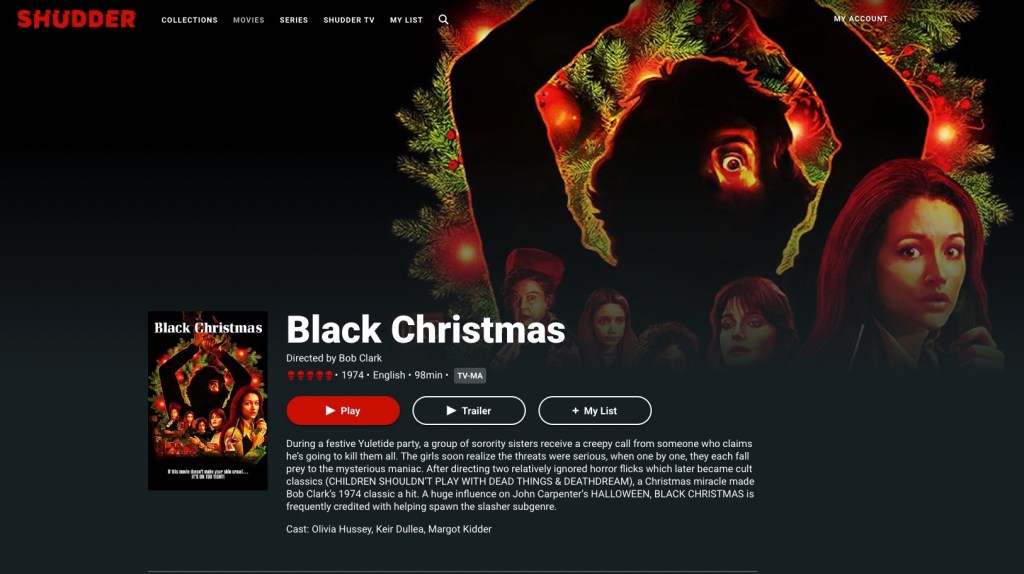
The O.G.
“If this movie doesn’t make your skin crawl… it’s on too tight!”
When Black Christmas was released in Canada in 1974 and the U.S.A. in 1975, this was its tag-line. (Fun fact for local film fans: here in Utah, it seems to have screened for from Nov. 5th through Nov. 11th, a single week, in `75; it didn’t last much longer elsewhere in the States.) Apparently, it received middling reviews amid a short first-take lifespan.
But then came Halloween (1978), Friday the 13th (1980), and the whole slasher cavalcade that followed.
In Black Christmas, we get all of the editing, sound, and POV choices that would become tropes within a decade of its release: the slasher-cam, the final girl, the one-by-one creative kills… it’s all there.
For those of you reading the Lake Witch Trilogy from Stephen Graham Jones (and if you’re not, what are you waiting for?), this is a must-see forbear of the current sub-genre and its meta-commentary sub-sub-genre (Scream and Tucker and Dale vs. Evil come to mind in film, and the Lake Witch Trilogy and I was a Teenage Slasher are our go-to examples right now in literature).
A few things Black Christmas did or didn’t include that shifted with later members of the club:
- Nudity. I was honestly surprised that for a movie I expected to be setting the tone for the late 1970s through the 90s there was no skin. 40-year-old me is not disappointed, but 14-year-old me would have been. This is a huge step up from the usual “if you get naked, you will be dead soon” rule in slasher films and stories. Leaving it out improved the film.
- Social commentary: while meta-horror and especially works of literature often include social commentary in their stories, most slasher films are pretty much devoid of deeper meaning. In Black Christmas, released a year after the Burger court’s Roe v. Wade decision, a key sub-plot of the storyline is an argument between an unwed woman and her overrated (she realizes this soon enough) boyfriend about whether or not she’d keep her unwanted early-developing soon-to-be fetus. Her boyfriend accuses her of “killing a baby,” language used by the anti-abortion movement then and since, while she has her own ideas about who ought to be making choices about her body. This is major positive for this film; it elevates the story and increases the stakes far above what most slasher films manage.
- Acting: I’m being flippant here, but it’s true, and I don’t think many would dispute this claim: most slasher movies did not take themselves seriously, especially as the sub-genre grew into its own adulthood and became self-referential and its borders well-hewn. Black Christmas contains real acting from Serious Actors Doing Serious Work.
I can’t help but to compare this film to the 2009 remake of Friday the 13th, which follows all of the tropes (including leaving out the social commentary and including nudity-as-precursor-to-murder), and there’s no comparison. Maybe it’s not a fair fight. Okay. In a Violent Nature (2024) takes itself seriously as a film, something most slasher films haven’t done in a very long time, but Black Christmas has the edge here, too, despite the unique editing and slow-building tension in the newer film.
Margot Kidder was phenomenal in this film, too. You can watch an interview focused on her recollections of Black Christmas here—about being a woman in Hollywood, and about making horror films in her early career.

I definitely recommend this film for horror aficionados in general and slasher fans in particular.

 Whisper House Press
Leave a comment