
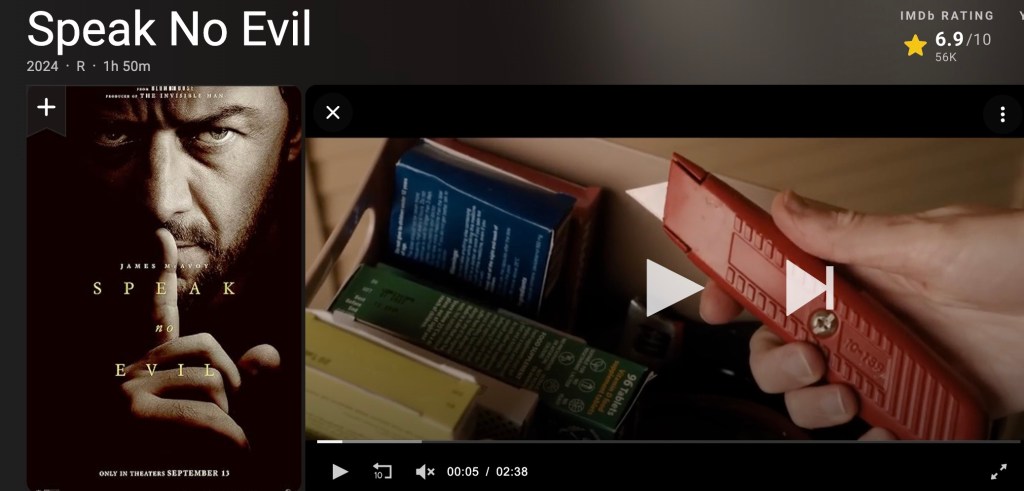
One interpretation of the edict “Speak no evil” holds one should avoid holding onto bad thoughts to avoid manifesting those negative possibilities in reality or driving oneself mad with obsessing over them. Such is the advice offered by Mackenzie Davis’s passive character Louise Dalton to her daughter Agnes halfway through the film Speak No Evil (2024, USA). “We don’t say everything we think” is her basic instruction to the uncomfortable eleven-year old discomforted in confronting their host West Country family’s culture. “Just be honest,” on the other hand, is the espoused motto of James McAvoy’s Paddy and Aisling Franciosi’s Ciara, Paddy’s wife. Ben and Louise Dalton wrestle with whether to take away their daughter’s favorite stuffie so she’ll act more her age, while Paddy and Ciara seem to taunt their own child over doing childish things in childlike ways. The escalation between the two families is slow, even agonizing at times, and the result is explosive.
I wrung my figurative hands upon hearing James Watkins was planning to revise and reshoot the 2022 Sundance-selected film Gæsterne (lit. “The Guests”, released under the English title Speak No Evil). Christian and Mads Tafdrup had wrought a horror film of the finest caliber, and I squinted at the thought American sensibility might improve upon it. (You can and should read my January 2022 rave review of that original film here.)
Why worry? Well, I had two reasons. The first was something I’m sure you’ve read about if you’ve been following the release of this film. Many suspected that perceived American bluntness would make the assumed-cultural-sensitivity requirements of the original film unworkable because they’d be unbelievable. Specifically: who would buy that loud-mouthed, ethnocentric Americans would stand by and say nothing when a whole bunch of weird stuff was going on around them? The movie can’t work if the Americans are all shouty and on-brand out-on-front-street. That’s the thinking, anyhow, behind worry number one, and I have to admit I shared it.
The second concern about an American remake, in a way, directly contradicted the underpinning assumptions of that first worry about American moral bullishness. All horror films are morality plays, in my mind, and Gæsterne was no exception. And what had made that film work for me, a particular audience member, was the third act taking subtle setups from the first two acts and paying them off with brutal and upsetting clarity, forcing a confrontation with one’s own assumptions about civility. It was the forcefulness of that confrontation I doubted big producer Blumhouse would go for. Would an American writer and producer risk American audiences’ peevishness and really go for it in act three?
The answer here was “yes and no.” To understand this response to the remake in light of its predecessor, you need to know something of what the Tafdrups explained in an online post-screening Q&A back in 2022. The writing duo told us the impetus for the film was a thought experiment. I’ll paraphrase: “You know how sometimes you meet lovely people while traveling abroad? If you really hit it off, you might exchange contact information and offer a place to stay, even promising to visit one another? Well, Gæsterne is that scenario played out in the worst way possible. We asked ourselves, ‘What’s the most awful way this could go down?’” And the Trafdup brothers got it right. That was, in so many ways, the very worst way that scenario could have played out.
And the truth is that some of this intensity in allowing the scene to play out logically is lost in the American version. In some regards, a lot of the impact is lost. And it’s not that it’s difficult for audiences to believe that an American family would remain mum in the face of upsetting-to-them cultural differences. We American audiences, I think, will totally buy this element of the Watkins film. But Watkins changes the ending, as you know, and I won’t spoil it here. I’ll only put it this way: the American film is squeamish and stops far short of the “What’s the worst that could happen?” approach to playing out this thought experiment. For that, and despite its deft inclusion of American gender differences and changing stereotypes (though slightly overplayed in this movie), it has turned out a weaker film in comparison to the masterful original. Many assumed it was American boorishness that would ruin the believability of this movie. Instead, it was pulling punches and a failure to follow through on the premise of the morality play set up in acts one in two that damages what was still an excellent film.
There were smallish gripes on my part—a less-than-consistent camera POV in the last stages of the film as well as jump scares rather than pervasive mood-setting used to ratchet up tension—but these annoyances don’t do much to diminish the overall good impression I’m left with after my first watch. Blumhouse’s Speak No Evil is very good. Watkins has written and directed admirably, and the film’s quality is enhanced with top-marks casting. Ironic: a movie with this title unwilling to depict what made the first film so shocking. No, this movie won’t shock you to your moral core as did its European counterpart, but the evil it implies is something equally—pardon the expression—unspeakable.
 Whisper House Press
Leave a comment