
Notes from the desk of the editor are offered in the interests of personal posterity and transparency for writers and other potential editors who wish to learn from my experience.
the editor
Some people panic during Kickstarter campaigns. Not me. I just get panic-ish. I check it no more than three times per day. Okay, five. Twelve. Depending on the day.
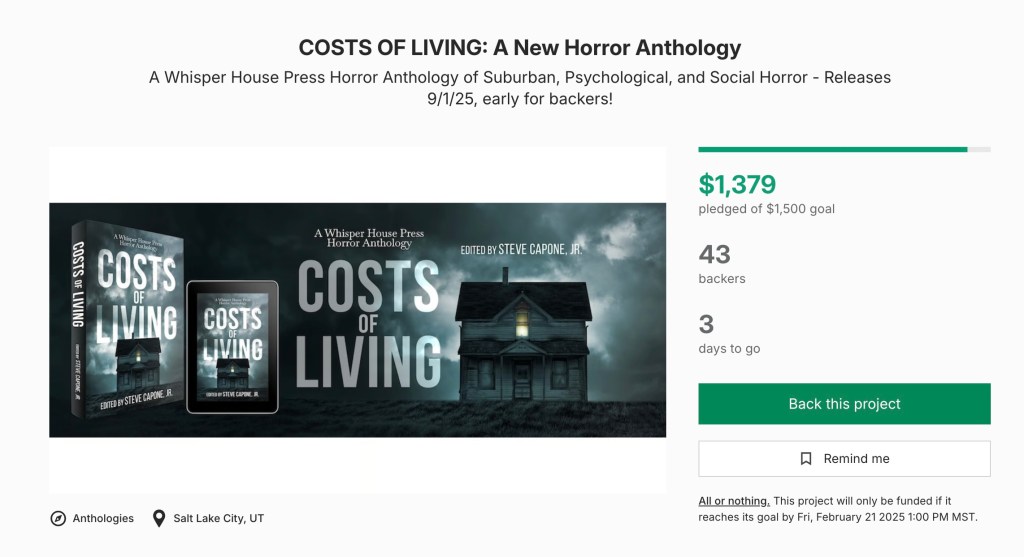
I have been posting on socials (Tiktok, Instagram, Facebook, Bluesky) as much as I think propriety allows. We got to 50% in the first 36 or so hours. (Studies show that projects reaching 50% in the first 24 hours succeed more frequently than those projects that do not reach that landmark. So we didn’t hit it, but we weren’t far off.)
Last year, I ran a kickstarter for my own personal project—unrelated to Whisper House Press—and in shooting for $1,000 I raised a bit over $2,000. Since then, I started the press and expended $6,100 (that’s somewhat a conservative estimate and includes every expense I tracked in FY 2024). It includes expenses related to starting the business, paying authors for Costs of Living contributions, for two Kirkus reviews (I pre-paid for the Dread Mondays review because of their once-yearly sale some time ago), and coffees drunk during work hours in shops (since I don’t have an office). It also includes payment toward a few of the authors for Dread Mondays (since all of my WHP expenses are tracked together—I should probably separate project budgets, right? Note to self. . .).
This time, my project aims to recoup some of those costs and is set for a $1,500 goal. It’s modest, but I know my audience isn’t huge. I know my reach isn’t sufficient to knock a $5,000 chunk out of the WHP expenses.
But this would help.
And we’ve got four days remaining. We’re hovering at about 90%. Now, on many projects, there’s a bit of a boost in interest from folks who have been waiting and watching to see if it’s likely to be successful, withholding their pledge until the final day. And then there’s a possibility that some folks will (eek!) cancel their pledges. In other words, it’s still possible. . . but nothing is assured. And if we don’t hit at least 100%, the whole thing fails. Ugh.
So yeah. I’m fine. But I’m kinda not. It’ll work out, either way. And we’ll get this thing published, either way. And I’m giving it my all, no matter what results from this fundraising effort. But whether or not my family remains supportive of my budget-ouchie projects will be in jeopardy.
It’s tough to start a business, I realize, with no expectation of any sales at all for the first eighteen months of operations. It’s all costs, no income. So anything I can do to claw back some money (that’s kind of a gruesome image, isn’t it?) will make it more likely my financial backers (that is, our family accounts) will continue supporting me.
So, behind the scenes this month?
I’m watching that campaign and thinking of stuff to add on that I didn’t think of the months prior. (I was mostly all set on these elements, but anything that can add value without adding costs to me is something I want to be able to add on—today it’s bumper stickers for any who want them. Mailing out stickers is a low-cost addition to the project, and it’s another little giveaway-type item that might nudge people toward supporting the effort.) I’m also reaching out to whomever I can think to reach out to.
For those of you considering running a Kickstarter. . . know this:
- Lead time is crucial, especially for your first few projects. Post your pre-launch page 90 days before your launch. You’ll need that time for design and for ideas that strike you as you research “best practices for kickstarter” etc.
- Design the landing page over time after getting the basics posted.
- Come up with cool names for your pledge packages, and have pledge levels across price points.
- Notice that your pre-launch page and your project page are two different landing zones. So be careful and ensure you test your landing links from accounts not logged into Kickstarter.
- You will generate most of the leads for your project. Do not rely on Kickstarter to provide you backers. People sometimes say that for every person you bring to the platform, Kickstarter will send a person your way. It seems to work more or less like this, but who knows? It’s not something I know how to measure.
Got questions? I’ve run two projects now. I’m not an expert, but I’m doing okay and have learned a lot—and I’m willing to help wherever I can.
Hopefully my next post will be about a second successful Kickstarter project. Wish me luck. And if you’ve got a buck, throw it our way, please and thank you.
– steve
 Whisper House Press
Leave a comment