

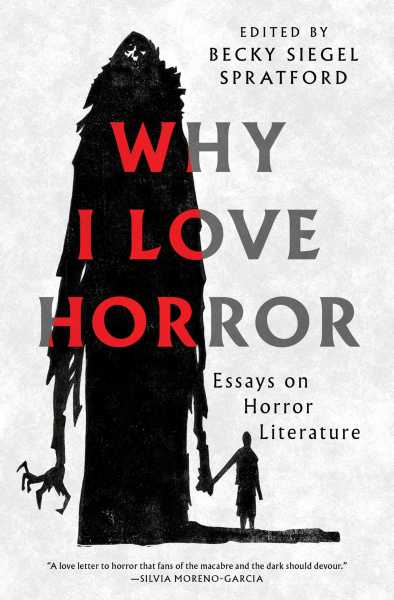
Book: Why I Love Horror
Editor: Becky Siegel Spratford
Publisher: Simon & Schuster’s Saga Press
Publication Date: 23 September, 2025
Capone’s Rating: 5 of 5 ⭐s
Let’s start this review by stating what might be obvious to you by just reading the list of contributors, whether or not you’re familiar with “horror librarian” Becky Siegel Spratford and her Good Works: Why I Love Horror is a must-read for any horror fan. This anthology of essays will appeal in particular to those wanting to get in the heads of favorite authors or, in the case of us horror writers, our heroes as well as favorites.
One point Stephen Graham Jones makes in his set-closing essay stands out among the rest: Horror is inclusive. We love it together, and our shared interest improves us and binds us. How deep does the binding go? How much blood would have to be spilled to break the curse—er, blessing? One can only guess. Thankfully, we know our shared kismet pulls us together in a welcoming community. I’ve felt that as a reader, writer, and publisher.
A few others remark in their essays that they came to horror somewhat late in life after making a start in the academy writing proper literary fiction (or attempting to do so) after realizing doing so felt hollow and untrue to them (my words, but that’s the gist). What struck me was how common my malady was in these writers whom I so admire. See, I also dismissed horror as uniformly dumpy schlock—I was as annoyingly pretentious as they come when the topic was literature. I read “only the classics” and avoided modern writing, in so-called genre fiction especially. Today, I realize that, while it was edifying to read all of that proper stuff, what really hits home today is the exploration only possible through that which is horrific. Some of that literary fiction appeals to me, sure, but mostly it feels stilted and contrived. The reins come off in horror, though, and we get to the meat of things much more clearly and directly—and clear and direct writing is good, right? It’s the best.
Writers like Tananarive Due talk about representation in horror, and for me, horror is an exercise in empathy without which I would see less of the world and those who inhabit it with me. Her work (see The Good House or The Reformatory, for example) has widened my own understanding of the world, and here I get a glimpse into her why. Malerman takes a less personal and more narrative approach, and his oddness definitely comes out in his essay. (Does the stranger on the train exist? Does Malerman?) Cynthia Palayo’s essay is heart-wrenching in its honesty, and I related strongly to her using horror and books and her comfortable writing office to stave off the outside. I get it, and though our experiences and perspectives are not the same, there’s so much she’s had to say that reaches me directly that I’m grateful to have read her essay and her fiction. Getting takes on horror from Hailey Piper, Jonathan Langan, Gabino Iglesias (who GETS IT), Jennifer McMahon, Paul Tremblay, and Grady Hendrix, among others (did I mention this crazy lineup?) was a treat.
This is a 5-of-5-star review because this book didn’t exist before and needed to exist. And here it is. September 2025. I’ve pre-ordered it for excerpts in my horror literature class this fall. Thank you, Horror Librarian!
My own why, dashed out in one sitting:
About six years ago, while I was amid writing my second or third young adult historical fiction novel, I had a conversation with the proprietor of my favorite local bookstore—The Printed Garden. We talked over our love of reading horror. We shared how intimidating horror was, as a genre, to write. It was hypothetical for me, as I had, in fact, never tried writing it.
As I always had done, I had been writing the sort of thing to which I was closest: at that time, it was spy stuff from the Cold War. I had been teaching mostly history to middle schoolers and was about a decade into an obsession with history, so it made sense that I connected with younger readers and was writing what essentially were historical adventure stories.
Horror was far from that, right? But it turns out—and I can only see this in hindsight—that I was secretly writing horror even then. My protagonist in Max in the Capital of Spies faces insurmountable odds and (spoiler alert) loses to the forces of totalitarianism in the end, though he saves himself. In so doing, he sacrifices his moral commitments for the sake of a love interest and his own more surface-level self-conception. This was intentional, and the turn at the end was a knife-twist, for sure.
What I didn’t realize was that this was a classic horror setup: protagonist faces insurmountable odds, is overwhelmed by them, and sacrifices something morally important for the sake of a desire. And while the book could never be marketed as straight-up horror, I seemed then as now to sneak horror elements into all that I do, just as I sneak philosophy and ethical questions into all that I do. I just can’t help it. It’s in my blood.
But I don’t like to be scared, and I swear I don’t know what horror is or how I write it. Sure, I have ideas, but it’s more of an aspiration than an understanding. I don’t set out to terrify readers, whether I’m writing my own stuff or editing a collection of others’ writing: I set out to communicate bizarre and curious circumstances, to see a character who we care about either making it through or failing to make it through those circumstances, and to run through thought experiments that parallel reality without being quite so scary as the real deal.
I live and have always lived my life in my head.
The people closest to me quake at the notion of living a day up there, and though I wouldn’t trade it for anything, I get it. My brain is a spooky place. I went through a period of psychosis when I was a teenager, and I believed—truly believed—my parents were government agents running tests on me and observing results. While the psychosis is long gone, I still have flashes. Every time I touch the doorknob to my house, I secretly pray the family inside hasn’t been switched out for strangers (to me) who think I’m someone I’m not or who don’t recognize me at all. Each night when I stand in the bathroom and peer into the back yard, I expect to see someone standing there, staring back at me. When I climb into bed, I pull up my feet and never let them dangle. I always check the backseat of my car at night. When I’m crossing the street, I hope I’m not hallucinating a clear pathway to the other side. These are real thoughts that I have on not only a regular but a consistent basis.
Horror books and movies are nothing compared to what I’m really thinking, most of the time.
As many of the authors in this anthology express, I escape in a safe way through horror. If you do, too, you’re part of our community. If you’re in it for the chills, you’re part of our community, too.
To quote an excellent forthcoming Michael Wehunt novel I reviewed recently: You belong.
Back to BOOK REVIEWS.
 Whisper House Press
Leave a comment