
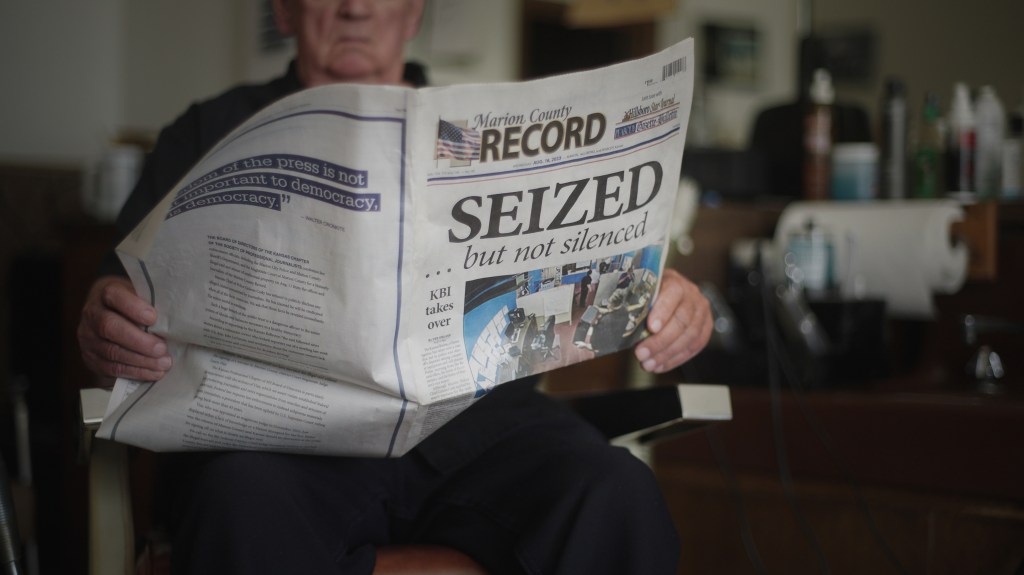
Film Title: Siezed
Director: Sharon Liese
Producers: Sharon Liese, Sasha Alpert, Paul Matyasovsky
Editor: Derek Boonstra
Release Date: 25 January, 2026 (Sundance Film Festival)
Capone’s Rating: 1 out of 5 stars
This documentary is a prime example of how poor editorial choices can diminish an absolutely vital story. By focusing on the wrong narrative elements available to them, the filmmakers rendered a critical constitutional battle far less important than it is. I cannot decide if we’d be better off as a viewing public without this film than with it.
The film provides the wrong context, largely framing the conflict in Marion County as a petty tiff between emotional actors rather than a high-stakes violation of civil liberties. By centering the narrative on the Record’s unsympathetic editor-in-chief-a figure who comes across as more vindictive than victimized-the filmmakers lose the opportunity to highlight the actual belligerents: the agents of the state. Hearing a vindictive old fella complain about the “death of journalism” lacks the necessary impact to convey the magnitude of the Sheriff’s Department’s wrongdoing.
Even the younger reporter at the Record, who seems to recognize his boss’s ethical lapses, is underutilized-though his clearly naive perspective would not have saved a film so fundamentally misaligned.
The story of an abusive police force raiding a newspaper is essential, yet this film downplays the state-sponsored constitutional violations to the detriment of its own message. (The on-screen text and the voiceovers in the last two minutes of the film do more to call out what’s most important about the story than the other 99% of the film.) While it’s difficult to dismiss a film with such an important subject, this specific execution does more harm than good. The film trivializes the gravity of the raid by failing to place it in a context larger than Marion County, Kansas.
So far as the First and Fourth amendments’ causes are concerned, there exists a legitimate question as to whether this film does more harm than good. Because the constitutional stakes are so deeply obscured by the focus on the personalities of unsympathetic combatants, the defense of the free press is stripped of its gravity. The result is a film that inadvertently provides ammunition to critics of the media, making what could have been a principled stand for civil liberties look like a self-indulgent complaint. I therefore wonder if Sundance’s own editorial choices have undermined the fight for journalistic freedom and for constitutional protections by promoting (by screening) a film that does so much to weaken the import of one of the decade’s biggest threats to it.
In the end, this story should be (read: must be) told, but it shouldn’t have been told by this creative team and in this manner.
 Whisper House Press
Leave a comment