
Film Title: Soul Patrol
Release Date: January 25th 2026 (Sundance Film Festival)
Director: J.M. Harper
Producers: Sam Bisbee, Danielle Massie, J.M. Harper, Nasir Jones, Peter Bittenbender
Capone’s Rating: 4 of 5 stars
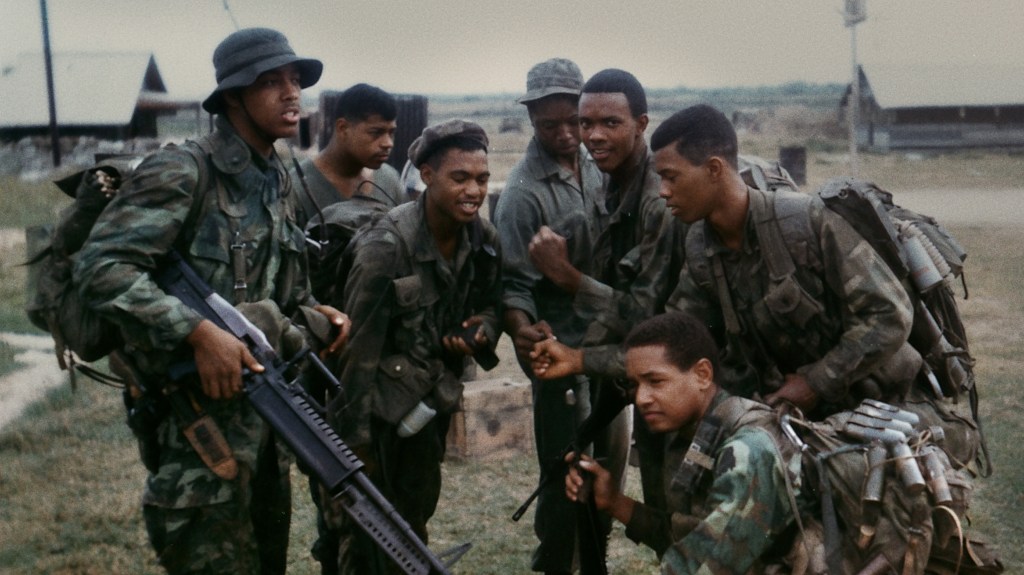
Soul Patrol tells the highly personal story of the lone African American long-range reconnaissance patrol (LRP, or more commonly “lurp”) in Vietnam within the larger context of one of the wars America would rather forget. While a war against racist policies and people was underway at home, around three-hundred thousand Black Americans fought a war against [hypothetical] oppression and the so-called Communist menace and died in numbers vastly disproportionate to White soldiers.
As a public historian who writes extensively about events and America’s worst tendencies, I want to know all I can about the Black Power Movement, and while I know plenty about the influence of McDonald’s franchises in Black communities and the turn of citizens frustrated by the Civil Rights Movement’s half-measures, I knew nothing of the extension of that movement to soldiering in Vietnam. I’m grateful for the compelling brand of education this film provides. While in 1967 Martin Luther King Jr. was speaking against the war in his “Beyond Vietnam” speech—decrying the hypocrisy of fighting oppression abroad while stoking it at home—these men were fighting under the American flag on the other side of the world. Their service was part of a grim reality: Early during the surge of troops in Vietnam, Black Americans died at twice the rate (~12% of the population, 25% of Vietnam deaths) of White soldiers while facing explicit racism from the 82nd Airborne and the military they served.
In this film, I met the patrol’s members, their varying perspectives showing the experiences of some of the soldiers who paid for America’s hubris with their lives. Their voices:
“An all-Black LRRP team is unheard of. […] We were the first and only spec op team in the Vietnam War”
“We had nothing to prove as an all-Black LRRP team. We just did our job and that was enough.”
“I wasn’t a ‘soul brother;’ I was a soldier. The only reason I went along with ‘soul patrol’ was because the other guys didn’t give a shit.”
“It didn’t bother me being called ‘soul patrol’.”
The newsreel footage—along with recordings of MLK, Malcolm X, John and Robert F. Kennedy, Marcus Garvey, and other key figures—provides the broader scope framing the round-table reminiscences of surviving soul patrol members. R&B songs provide the soundtrack. Reenactments provide movement to the voiceovers of team members whose war scenes could not have been filmed, and the soldiers’ own Super 8 footage intersperses the rest.
One LRP member realizes while on R&R that he was fighting people who were just like him: “I knew when I got back I had to do my job, and that just ripped me apart.”
Existential worry pervades. Friedrich Nietzsche quotes are thematic anchors asking who we are as humans and what impact our choices have on how we see ourselves. Viewers are challenged to ask about the difference between Americans and our so-called external enemies while we still treat those at home as we do.
This film is not exciting, but it doesn’t try to be. It is poignant. It is measured. It’s real.
 Whisper House Press
Leave a comment