

Note: New Photos Included! Reliable Internet Access Acquired.
Rothenburg ob der Tauber (over the Tauber [river]). What words can I use? I had thought that Würzburg was my favorite small town in Germany, but as quickly as I came to favor Würzburg, I have chosen a new favorite. I had done my research, as usual, so I already knew that Rothenburg boasted the oldest continually standing city walls in Europe, but I didn’t know much else about it.
It is a village deposited on the German countryside directly from a fairy tale. Many of its central buildings were built in the 16th and 17th century, but the fact that it was founded some 1,000 years ago and is still only host to around 10,000 inhabitants (many of whom live outside the city’s walls) lends a strong impression as one wanders through the town. Probably because it’s smaller than the other towns I’ve visited in Germany (even smaller than Füssen at the edge of the Alps), not quite so many tourists fit within its walls at any given time than in the other cities. Of course, they all tend to congregate on the city’s main road, so while I used it once or twice to make a bee-line through to its other side, I found a more appealing way of circumnavigating the town: the walls.

It is possible in Rothenburg to climb some stairs and walk along an entire side of the city on an elevated defensive wall. This option provides the dual benefit of giving one a sense of being removed from the (other) annoying tourists while also offering spectacular views of the buildings and layout of the town.
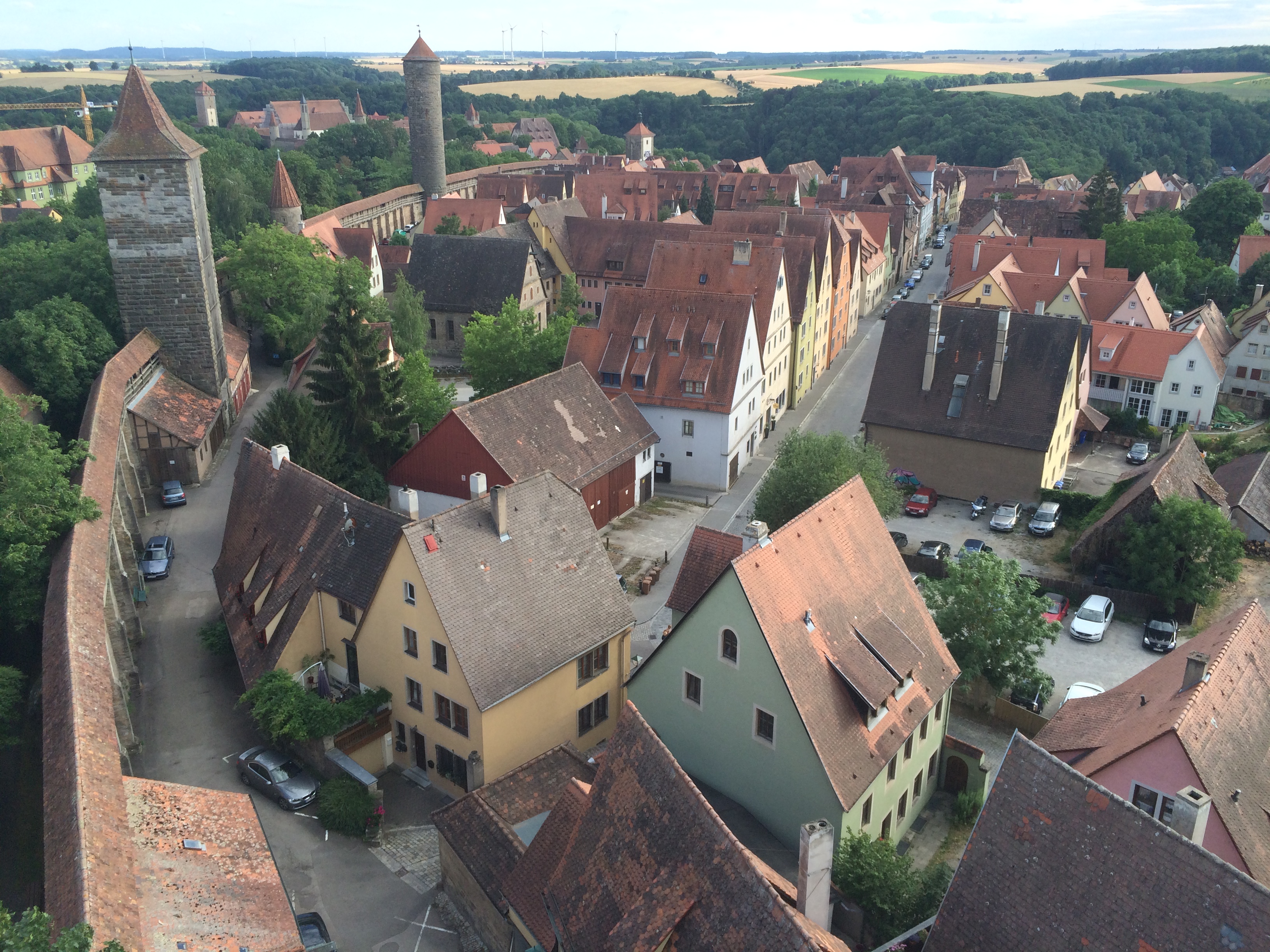
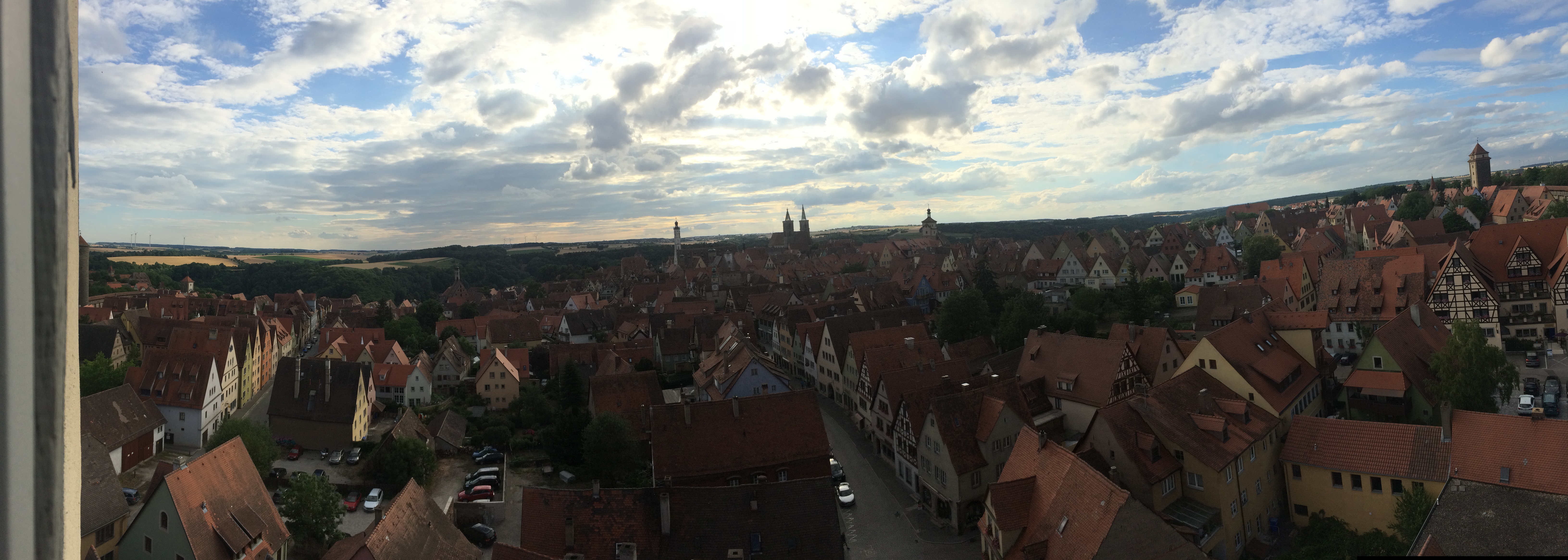
Situated above the central city gates, there’s one main tower that visitors can climb (the stairs are steep and the climb is long!) to get a panoramic view of Rothenburg and the surrounding countryside. Immaculate.
Rothenburg reminds me of Česky Krumlov in Bohemia (in the Czech Republic). That, too, is a town forgotten by history and left largely alone for 500 or more years. Unlike Rothenburg, Česky Krumlov wasn’t bombed during the war (some 40% of this town was partially or completely destroyed during the Allied battle against German morale – there were no military or industrial targets in the area). Still, what was lost has largely been rebuilt in the old style, and one wouldn’t know that the town was damaged from its present, fantastical appearance.
Aside from my two- or three-hour stints wandering the walled portion of Rothenburg, I spent many hours walking through its surrounding forests and hills, and my-bed and-breakfast lodgings were nestled into a less-traveled part of the region. A backyard, babbling stream provided the acoustic ambiance for one of the most pleasant stays I’ve had anywhere on any journey. The farmhouse, built in 1921 but recently modernized, was comfortable and quiet – my two qualifications for a successful, if temporary, residence. I surely will look back on my four nights in Rothenburg with great fondness, and I hope to return soon!

 Whisper House Press
Leave a reply to Nicolle Novak Cancel reply