
Notes from the desk of the editor are offered in the interests of personal posterity and transparency for writers and other potential editors who wish to learn from my experience.
the editor
How to write a third-person bio
I’ve had a few folks ask me for tips or direction about how to write a third-person biography.
What it’s For
Many calls for submissions, including our own, ask for authors to submit a third-person bio along with their cover letter and piece of writing. The reasons are twofold: (1) we want to get to know the writer, and (2) we want to have the text we’ll use in an “about the contributor” section of the blog post or book.
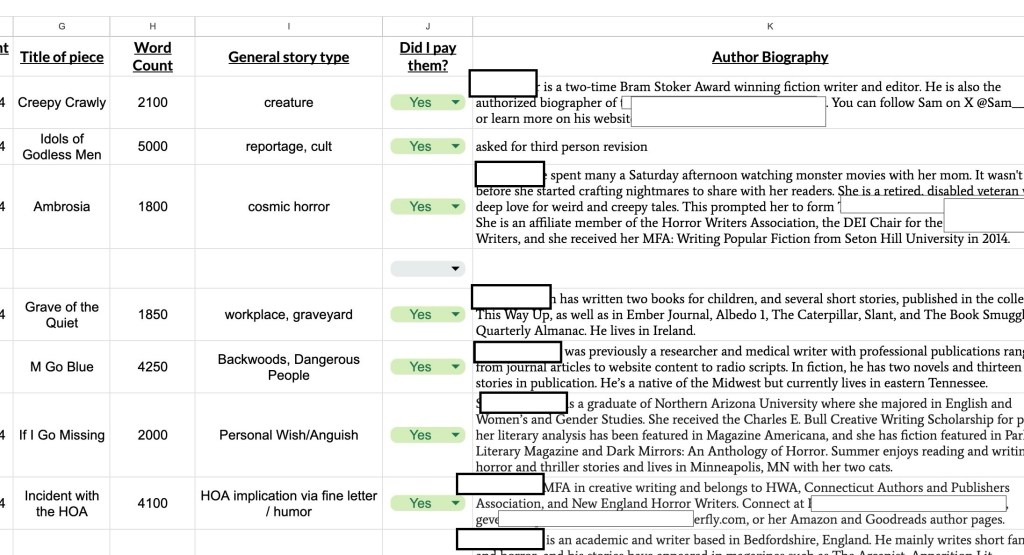
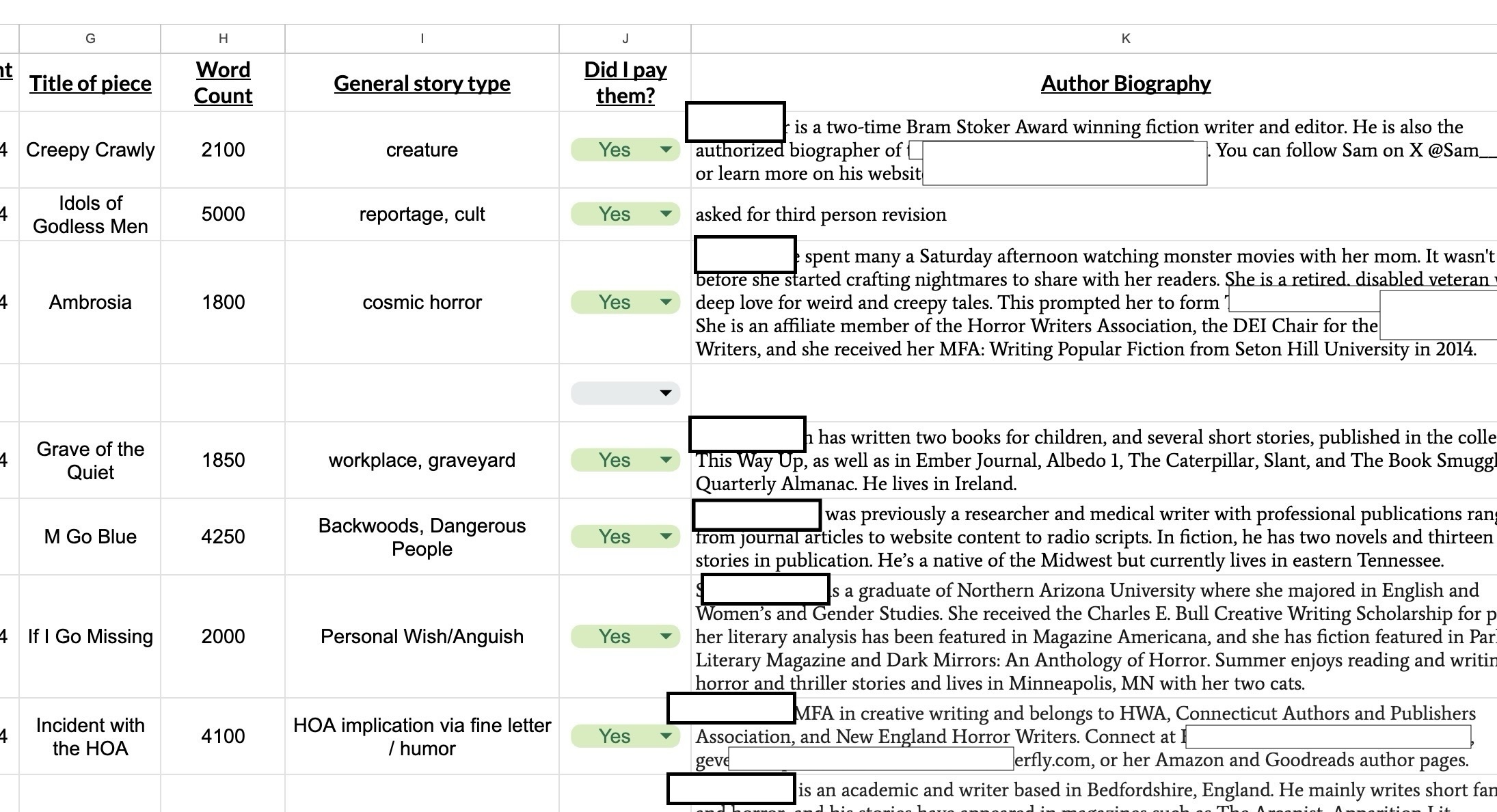
In the case of our inaugural anthology, the editor (that’s me) is gathering the third-person bios in the tracking spreadsheet that’ll be crucial to designing the book block (the compilation of all the book’s contents).
What to Include
If you’ve published before, include something about that. You don’t need to (and it would be garish to) include everything you’ve ever published, but if you’ve authored a book people might know or is your pride and joy, list that here. If you’re a member of a professional organization (such as the Horror Writers Association or League of Utah Writers or Writers Guild of America) include that, too. If you have a quirky thing that uniquely identifies you (I rescue dogs and like pizza a lot), you might want to include that. Perhaps you’d include something about the region where you live or your place of birth. It really depends on the set of identifiers you’re working with. Later-career writers will want to list awards or shortlist publications. If you’re an endowed chair of whosits, that’s going on the list… you’ll want to customize a bio for the particular use. For instance, when I present to teachers, I emphasize my teaching chops
Examples
As I noted above, the material included in a bio depends on its use. Here’s one I used recently for inclusion in a conference program:
Steve Capone Jr. (M.A., M.S.) has taught students in grade two through the undergraduate level since joining the profession in January 2008. He’s a board member serving the Utah Council of the Social Studies (UCSS) and the Utah Middle Level Association (UMLA) and works under contract with the Utah State Board of Education to provide professional development to licensed educators and to create and review microcredentials in the state’s Midas P.D. system. Steve is also a Horror Writers Association-affiliated author as well as the founding editor and publisher with Whisper House Press and brings his varied experiences into the classroom at every opportunity.
Here’s what I included in a recent submission to a reviewer:
A multi-genre, Utah-based writer hailing from the Rust Belt, Steve Capone Jr debuted his YA historical/espionage fiction novel Max in the Capital of Spies: A Max Fredericks Story in March 2024 following a successful Kickstarter campaign. Kirkus reviews called this debut “clever” and remarked, “The strength of Capone’s work is the thorough research that informs his depiction of 1960s East Berlin and the authenticity it adds to his narrative; he’s set a high bar […]”. In 2026, Gibbs Smith’s True Fiction Press will distribute Capone’s next scheduled release, Jimmy vs. Communism, nationwide. You can find his short fiction anthologies such as We Are Dangerous (LUW Press, 2023) and This Isn’t the Place (forthcoming 2024, Timber Ghost Press). Steve is a long-time teacher and researcher, pizza advocate, dog rescuer, and member of the League of Utah Writers and the Horror Writers Association.
I had less space for a submission in January 2024 to an anthology call, so I truncated things as follows:
A multi-genre, Utah-based writer hailing from the Rust Belt, Steve Capone Jr debuted his YA historical/espionage fiction novel Max in the Capital of Spies: A Max Fredericks Story in March 2024. In 2026, Gibbs Smith’s True Fiction Press will distribute Jimmy vs. Communism nationwide. You can find some of his short fiction in the We Are Dangerous and This Isn’t the Place anthologies. He’s a pizza advocate, dog rescuer, and proud member of the League of Utah Writers and the Horror Writers Association.
I’m realizing with each of these bios that I didn’t include the awards I won from the League of Utah Writers, which might be a nice thing to include. The tricky part of all this is that there’s usually a wordcount cap (sometimes as few as 50 words), so getting the info in that you think most important given your intended audience is the real challenge.
A last consideration
If you’re contributing to an anthology, you will likely get a second look at your bio before things go to press, often alongside the other contributors’ bios. This comes during the galley proof stage just before printing, and while major changes in the galley stage are a faux pas, you can shift somewhat at this point if you feel you must. In the case of our press’s first anthology, Costs of Living, we’ll have an intentional and explicit round of reviews prior to the galley stage during which contributors can adjust however they see fit (within word count limits).
I hope this little intro to bios has been helpful. Let me know if you think I’ve missed something important! Email me at editor [at] whisperhousepress [dot] com.
Click here to return to the “Behind the Scenes with Whisper House Press” Headquarters.
 Whisper House Press
Leave a comment