
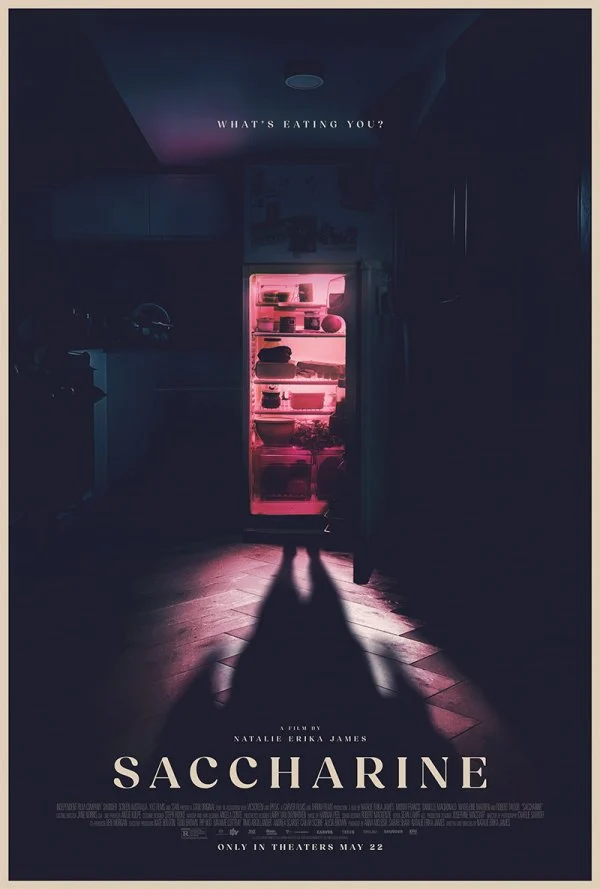
Film Title: Saccharine
Director: Natalie Erika James
Screenwriter: Natalie Erika James
Actors: Midori Francis, Madeleine Madden, Danielle Macdonald
Country: Australia
Distribution in U.S. and U.K.: The Independent Film Company, Shudder
Initial Release (USA, Sundance): Jan 22, 2026
Narrow U.S. Release: May 22, 2026
Shudder Streaming Release: “later this year [in 2026]”
Capone’s Rating: 5⭐ out of 5⭐
Content Notes: disordered eating, addiction; you will feel uncomfortable.
Today, two days prior to release, I’m previewing the film Saccharine, which will see a limited release in U.S. theaters this Friday, May 22nd 2026. The TLDR here is that I want you to go see this film and report back. Chances are, there’s at least one screen showing it within a decent drive for most of you, and it’s worth a trip. Here in Utah, it’s not showing at Cinemark, and it’s not at Megaplex (a regional chain competing with the big boys), but it is at one AMC about a 30-mile drive from home. And I’m going to be making the trek to see it again. It’s so, so good. Let’s dive in (without spoilers beyond thematic notes).
In brief, and not to spoil beyond what the logline and brief description would tell you on their own, the film follows Hana, a second-generation American protagonist who chases ideals: She wants to be a medical school graduate, to boast a fit figure, and to find love. Perfection in the basics. But she is struggling. She wants to lose weight, and she wants it so badly that she’s willing to try any fad if it works and is scientifically testable. Enter: a little capsule that checks both boxes, and several others besides.
I attended Saccharine’s Midnight (a film category at Sundance Film Festival) release back in January, and it stays with me as easily the top film of the 15+ feature-length films I saw at Sundance 2026. I’m somewhat predisposed toward ornariness around midnight releases because my bedtime is well before midnight, and I resent anything that keeps me out late without paying off bigtime. This film paid off. Here’s what you should notice as you watch:
Complex, challenging themes. The story here is meaningful. Natalie Erika James has written from a personal place, as actor Midori Francis’s protagonist Hana is wrestling with intersecting challenges of addiction, cultural identity, body image, and romantic relationships. And there are issues of sex and gender here, too. Unfortunately, there are layers of this film toward which I am largely blind—issues of race and gender and a confusing and frightening relationship with food, particularly—and so I will only acknowledge these and suggest that, if you’re a different sort of person, you’ll likely get even more from the film than I did. James, the director, spoke during audience discussions in January about writing from the perspective of a person who’s experienced the ups and downs of recovery from addiction, and this speaks to me personally—I’m a person in long term recovery, since 1999. This film gets those feelings right, uncomfortably but compellingly enough.
Production Design. I was a Q’er in the Q&A part of the screening at Sundance 2026, and I asked about the color palette. The pink and orange hues are everpresent in Saccharine, and the scene-settings, costumes, and lighting do tremendous but subtle work throughout. I asked about the director’s vision. Was the production design an execution of that version and the themes of the film, or were these elements more production-design choices? The answer should have been obvious, but it wasn’t, to me: The team went back and forth, collaborating and developing. The expertise and precision was largely that of the production designer, Josephine Wagstaff. Watch closely.
Acting. The aforementioned Midori Francis is phenomenal. She embodies this character, Hana. It’s real. It works. Her counterparts, Madeleine Madden and Danielle Macdonald, are pitch perfect as foils, counterparts, and compassionate collaborators.
Cinematography. The shot-framing is intentional and contributes to the vibe of the scenes. Looking down (or up) a shaft at a character wishing she were somewhere—perhaps someone—else offers a distinctive feeling that works all the better for the craft of the camera work.
Some folks took issue with my social media posts decrying the new release Obsession last week. (I didn’t feel it worth adding my voice to Robert Zerbe’s effective notes last week, especially when I didn’t have anything good to say.) On TikTok and Instagram, I complained briefly about the writing, about the camera work and sound design needing to do all the heavy lifting for tension as opposed to the ideas, acting, and dialogue, and I griped about the protagonist being so damned dislikable from the very start of the film. The movie felt shoddily put together, generally. But notably, I wasn’t frustrated with the tropey “wish gone wrong” vehicle; I wanted the film to work. And truly, there aren’t many (if any) new ideas out there. What I care about is the execution of whatever idea is at the core of the story. And Saccharine is another “wish gone wrong” film, though I didn’t see it that way at the time. But this movie gets right all the places where Obsession took a wrong turn.
For fans of the subgenres of food horror, pink horror, body horror, psychological horror, and what has at times been called “elevated horror” or “arthouse horror” (yuck to both forms of nomenclature), Saccharine is a 5-star film you should drive to the nearest screens showing it to see. Otherwise you’ll need to wait for it to stream on Shudder “later this year,” which should be your opportunity to rewatch Saccharine.
Leave a Reply