
Welcome to a new series of horror film reviews. In the “It Came From the Crypt” sequence, we’ll get horror writers’ take on spooky movies that influenced them. Think of these as combining film reviews with personal essays.
If you’d like to submit a “from the crypt”-style review of a film that had an impact on you as a horror writer, please email your completed review along with a sub-150-word bio to Steve at editor [at] whisperhousepress [dot] com.
The first in this series is from S.T. Talbot, whose “Connor the Canary” short is July 2026’s featured story. “Connor…” will also appear in our year-end volume of collected features, Year Two: A Whisper House Press Horror Anthology—you should pick this up in November 2026. His work—”Feed Creep”—also appears in this October’s Doom Scroll, an anthology of social media horror stories. In short, you’ll be hearing a lot from Talbot, and we’re grateful for his contributions.
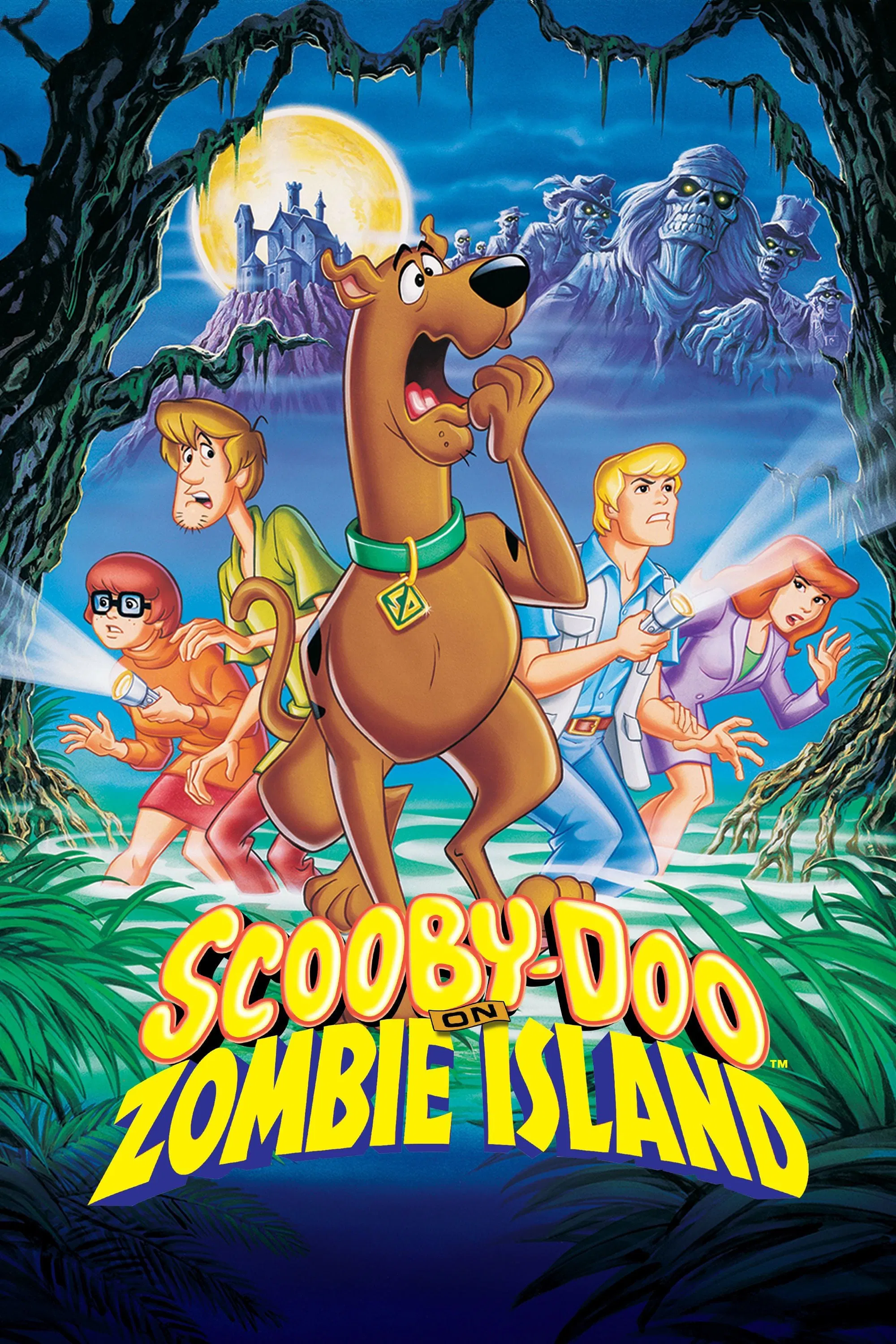
And without further ado… Here’s S.T. Talbot writing on Scooby-Doo on Zombie Island.
It’s difficult for me to review a movie that I watched regularly growing up. The closer a movie is to being important to me, the harder it is for me to put into words what I like about it, and this movie is nothing if not important to me.
I grew up with what I used to think of as my parents’ version of Scooby-Doo constantly playing at home. You get used to the formula, and it becomes something of a comfort blanket: the gang stumbles onto some mystery that takes place in a spooky mansion or a foggy town—or a spooky mansion in a foggy town. A small cast of eccentric, potential culprits is introduced, and clue by clue, joke by joke, the gang of archetyped teens solves the mystery and ties it up neatly with a bow.
The first time I saw Scooby-Doo on Zombie Island, the rug was pulled out from under me fast enough to give whiplash. It starts familiar enough—a cold open in which the crew unmasks a real estate agent posing as a monster so he can print counterfeit money. Following this unmasking, the crew loses its spark, tired of each subsequent mystery ending in rubber masks and meddle-taunting.
The gang splits up. Fred and Daphne start a TV show trying to find evidence of real ghosts. Shaggy and Scooby work at an airport, and Velma owns a bookstore that specializes in the mysterious and macabre. This was the first sign that this was not my mother’s Scooby-Doo. The members of the gang existing outside of the gang itself, working jobs, paying bills—this held Lovecraftian levels of existential dread for young me.
The gang gets back together for Daphne’s birthday and decides to work together on her show. They road trip across state lines only to uncover more of the same rubber masks and meddle-taunting that split them up in the first place. They arrive in New Orleans, all but ready to accept defeat and admit the paranormal doesn’t exist.
This fucked me up too. I just finished watching the gang come off of one of the most incredibly crafted Scooby-Doo montages of unmasking villains, only for them to end up depressed and hurting on a park bench outside a market. It felt so wrong. This is their thing; they are supposed to love unmasking the bad guys. Seven-year-old me felt like this was the juiciest, spookiest episode of Scooby-Doo Where Are You!, and the gang was indifferent. Watching Daphne flirt with defeat on that bench made me realize one day Shaggy might experience male pattern baldness and work as a bank teller. It made me question Scooby-Doo’s lifespan. A Great Dane lives to be maybe ten years old, and ol’ Scoobert was 30 years deep into mystery solving…
A woman named Lena overhears them talking about their inability to track down the paranormal, and invites them to take a tour of where she works: a haunted pepper plantation called Moonscar Island. The gang decides they have nothing to lose, and follows Lena to the ferry that takes them to the island. They meet the owner of the plantation, Simone, the suspicious gardener, and a collection of cats that call the island home. Lena and Simone swear up and down that the ghost of a pirate named Morgan Moonscar haunts the island. The gang is skeptical, and approaches the mystery as they would any other: looking for smoke, mirrors, and potential hidden treasure enticing enough to have someone go as far as fake-haunting the island.
Once they reach the island, it reestablishes the tried and true Scooby-Doo formula. Shag and Scoob eat, cower, and beg to go home. Velma is determined to solve the mystery and hits the books. Fred has eyes for Lena, and Daphne rolls her eyes at Fred. Familiar, but different enough to leave a seven-year-old me off-kilter. The gang is more fleshed out. This is the first Scooby-Doo to make me feel like these characters all went home after they solved a mystery. They’re also self-aware, poking fun at past iterations of themselves. Different, but I could handle a little meta.
What I couldn’t handle? The stakes. It’s pretty clear early on that the gang is dealing with an actual haunted island, and they are wholly unprepared. Just the idea of Scoob and crew interacting with actual ghosts is enough to turn the formula on its head. If the ghost of Morgan Moonscar was the only thing haunting that island, this would still be a slam dunk.
But they just keep upping the ante as the movie progresses, though. It’s not enough that there’s an actual ghost, but the island is also full of zombies. Everyone besides Shaggy and Scooby thinks this is an elaborate hoax. It all shifts when Fred and Daphne attempt to unmask a zombie they have captured. The sequence of them pulling his face skin taut as they attempt to remove his mask has always stuck with me. It somehow had more of an effect than when they accidentally pull the zombie’s head off and play hot potato with it a few seconds later.
This felt illegal. The feeling of safety Scooby-Doo is supposed to invoke was shattered the moment Fred casually yanked that zombie’s head off. Watching as a kid, part of me was sure there was still some rational explanation for ghosts that could lift people, and an island full of zombies clawing their way up from the earth. I just could not fully accept what I was seeing on screen—and that’s when the were-cats come into play.
The two sweet women who invited the gang into the plantation turn out to be were-cats. Their origins are revealed in a particularly brutal, grainy flashback where Moonscar and his crew drive the settlers into the bayou to be eaten alive by alligators. Lena and Simone were the only survivors, and they prayed to their cat-god seeking revenge. Their prayers were answered, but they were cursed in the process, needing to drain the souls of unsuspecting victims each harvest moon to keep their immortality. The zombies shambling around the island being casually decapitated are nothing more than the previous victims of Lena and Simone.
I wish I could have seen my face the first time I saw the final act of this movie. I’m sure my facial features were animated as I realized there were no rubber masks or animatronics. There were real monsters and death in place of the smoke and mirrors I’d come to expect. I can only imagine the way my face contorted when the two women transformed into cat-beasts for the final showdown. When the were-cats are finally defeated, they dissolve away into dust, and you get a peek at their elongated, chimera skulls for half a second before they blow away with the wind. I used to have nightmares about those skulls.
Even the most popular complaints about this movie just work for me. Hell, I think Billy West might be my favorite voice for Shaggy. His performance is subdued, less cartoonish, which works well for such a dark version of Scooby-Doo. I can’t say anything about the music that hasn’t been said a thousand times before. The songs from this movie have been getting stuck in my head for over twenty years—quite impressive.
This movie was one of a few important relics from my childhood that helped spark my lifelong love of horror. If you could reverse-engineer my tastes, a lot of paths will lead back to Zombie Island. The music, atmosphere, and plot. The animation, scares, and subtext. The way it sneaks in and lodges itself in my brain when I let my guard down. The familiar comfort that envelops me anytime I hear the intro music—it all adds up to this being the most important movie in my life.
S. T. Talbot has been writing since he was a boy, but he took up writing fiction to process living in an unfamiliar environment following his move from his hometown in the San Bernardino mountains to Florida. If he’s not at work staring blankly at clipboards or in his office conjuring up ghost stories, he’s most likely listening to spine-chilling old-time radio shows or gorging on cheap, foggy horror films with his cat, Casper.
You can find Talbot on Instagram @s.talbot.writes
Leave a Reply