
by D.J. Tuskmor
[editor’s note: the Event Horizon (1997) essay contains spoilers — proceed into hell with caution.]
I was a child of the 90s, which means I was raised on a steady diet of science fiction.
My earliest memories with the genre are watching Star Trek with my grandmother while she babysat us, or going to see the Star Wars re-releases in theaters with my dad. I loved spaceships, aliens, ray guns, far-off planets—all of it. More than the fun stuff, what I loved about sci-fi most was how hopeful the genre could be.
Humanity might run into some horrible shit out among the stars, but at least we had made it that far. We’d found a way to come together, build the ships, cross impossible distances, and help civilizations waiting for us. Even when things went bad, there was usually some sense that the good people would figure it out in the end. Maybe that lesson was all my pre-pubescent brain was able to pick up on, but outer space felt like somewhere we were supposed to go.
So, when I was around eleven and got my hands on a little science fiction movie called Event Horizon, I thought I had a pretty good idea of what I was getting into.
Before I get into how Event Horizon permanently shredded my psyche and altered the course of my development, there’s one important thing you need to know about me at this point in my life. I was a Grade-A Weenie. I was afraid of everything. I once saw a commercial for an interview with a crackpot who swore he had been abducted by aliens, and I spent the next month convinced that aliens were going to abduct me.
I caught a glimpse of Pennywise the clown and spent months staying up most of the night watching the closet doors at the foot of my bed, sure as I could be that an evil clown was going to crawl out of there the second I let my guard down.
How does a kid afraid of their own shadow end up watching Event Horizon? Well, it’s simple. It was a science fiction movie with the dude from Jurassic Park. Who didn’t love Jurassic Park? As far as I was concerned, Sam Neill was going to get on a spaceship, help rescue some people, and probably explain a bunch of cool science along the way.
In typical 90s fashion, the movie opens on the deep, dark expanse of outer space, slowly transitioning toward a black hole while the cast’s names scroll across the screen.
We get some information fed to us in white type across a black screen, letting us know a few key points in humanity’s history before we step into the action. In 2015, humans colonized the Moon. In 2032, commercial mining started on Mars. In 2040 the deep space research vessel Event Horizon launched and disappeared somewhere around Neptune, never to be heard from again. Now, in 2047, the Event Horizon has appeared, seemingly out of nowhere.
Cool. Young me is totally sold at this point. Let’s see some planet hopping, some alien fighting, some crew saving.
It only takes about five minutes for the movie to show its true colors. We see the Event Horizon floating through space, and the camera moves inside, drifting through hallways full of debris until it finds the cockpit. A body floats and spins in front of a cross-shaped window, the light behind it obscuring who we are looking at. The camera moves closer and reveals a bald, naked man with deep wounds and symbols carved into his face and body.
He smiles.
We jolt out of a nightmare imagined by Dr. Weir, played by Sam Neill.
At this point, knowing what you know about me at this stage in my life, you would assume I shut the movie off. I did not. I knew I was in for a bad time, but I had something going for me that was greater than courage: peer pressure. I had selected Event Horizon for a sleepover with two friends who were a couple of years older than I, and they’d already found the selection “lame.” There was no chance I was going to admit the movie scared me five minutes in.
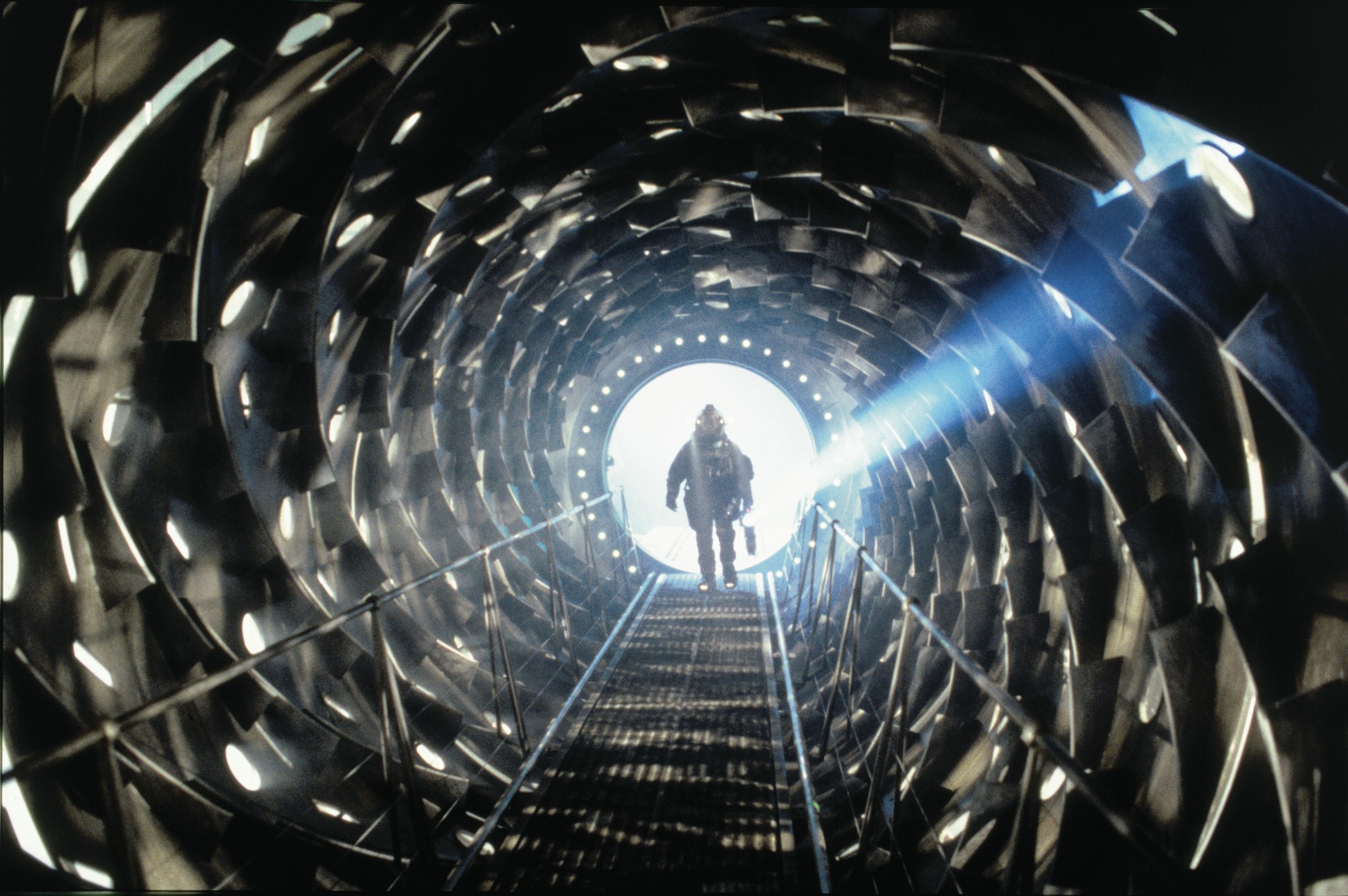
Even though Event Horizon went on to scar me, it was also doing something else to my brain, which, I guess, is thematically appropriate. From the latticework space station in the opening, to the gravity couches meant to protect from high-speed travel, down to the brutalist-adjacent retrofuturism of every set and piece of equipment, Event Horizon ingrained in me a deep love for a particular kind of gritty, analog science-fiction aesthetic that I still seek today.
It took a little longer for the horror to get its hooks into me.
By the time the Lewis and Clark reaches the Event Horizon and suffers a catastrophic failure that forces the crew to board the abandoned ship, we’ve met the rescue team: Captain Miller, his second-in-command Starck, pilot Smitty, medical technician Peters, doctor D.J., rescue technician Cooper, and engineer Justin. Weir, meanwhile, is along because he designed the Event Horizon’s gravity drive.
Crew member Justin disappears into a black hole at the center of the gravity drive, despite Dr. Weir insisting this should be impossible. The spherical room containing the gravity drive is also covered in huge metal spikes, which in no way made me question what horrors might exist beyond the triple magnetic field containment system of the drive.
Somehow, I was actually starting to dig this movie. It’s basically a thriller, right?
Wrong, little me. Oh, the hubris.
This is around the point in the movie where Weir and company start seeing things. Miller sees a burning man step out of the water surrounding the gravity drive. Peters sees her son, his legs covered in bloody lesions. Weir sees his dead wife beckoning him to join her. The ship has stopped being a creepy place where something terrible happened and started reaching directly into the crew’s heads. The Event Horizon becomes a character.
While some of the crew are outside repairing the Lewis and Clark, Justin wakes from a catatonic state caused by his sojourn into the black hole and enters an airlock. He rants about hell and the things he has seen and then hits the button to open the outer door while everyone begs him to stop. Miller is radioed for help.
Then Justin snaps out of whatever waking nightmare state he has been trapped in and immediately panics.
This part fucked me up. It wasn’t just the idea of his eyes bursting or his body exploding from decompression. It was the way he suddenly understood exactly what he had done. He cries. He begs for help. He calls Peters “Mama Bear” while she tries to calm him down. He is no longer some guy possessed by a haunted spaceship. He is just terrified and desperate for somebody to save him.
Everything ramps up from here.
D.J. tells Miller that he mistranslated an earlier transmission. What he thought was a call for help had been a warning: Save yourself from hell.
By now, my two buddies were also shitting themselves. I felt vindicated, maybe even a little excited. I was starting to like how scared the movie was making me.
Then we hit what, for me, is one of the two scariest scenes in the movie. The crew manages to unscramble a video left behind by the Event Horizon’s original crew. What they find is footage of everyone aboard killing and brutalizing each other in progressively horrifying ways, including their captain chanting in Latin while holding his own eyeballs in his hands.
Miller, no longer fucking around, watches the recording and immediately decides they are leaving and blowing the Event Horizon to pieces. Weir protests but is overridden.
Correct response.
The ship, and Weir, have other plans.
Things go to shit fast. Peters follows a vision of her son and falls to her death. Smitty is killed when the Lewis and Clark explodes, taking away their escape route, while Cooper is flung off into space. Then Weir attacks D.J. in the medical bay and vivisects him, leaving his body hanging above a table, hooks pushed through the skin of his back, with his chest held open and his organs spilled out beneath him.
To say this scene fucked me up is an understatement. To this day, I have a fear of surgery because there is no worse fate, in my mind, than being cut apart while you are conscious. I can trace that one pretty directly back to D.J.’s death.
Weir’s eyes did not help much either.
When Miller eventually confronts him on the bridge, Weir’s eye sockets have been stitched shut. The practical effects here are disgusting in the right way, and the image tattooed itself onto my brain. I have hated stitches ever since.
Thanks, Sam (RIP).
Weir initiates the gravity drive and the jump back to hell. Meanwhile, Cooper, who everyone assumed was dead, uses his spacesuit as a makeshift thruster and somehow finds his way back to the ship. He appears outside the bridge window at exactly the right moment. Weir fires at him, shattering the window and decompressing the bridge.
Weir, still strapped into the captain’s chair, is sucked through the window. Honestly, I always laugh at Weir being flung out the window. It does not look particularly good by today’s standards, but even for a kid there was something funny about seeing him blasted into space after everything the movie had just put me through.
The ship brings Weir back one final time, mutilated and covered in strange symbols carved into his skin. Miller eventually sacrifices himself to split the ship and save Starck, Cooper, and Justin.
Starck and Cooper wake to rescue a week later, though Starck briefly hallucinates the mutilated Weir is the rescuer,because apparently the movie wanted to get one last shot in before the credits rolled.
Nobody at the sleepover slept, and I got instant street cred for “picking a brutal movie.”
Event Horizon was my gateway to horror. Shortly afterward, I tried out The Exorcist, then Hellraiser, and I have not stopped since, even though I was scared shitless most of the way.
Looking back now, though, what surprises me is how specifically Event Horizon seems to have shaped the kind of horror I love. The movie is full of people carrying around trauma, guilt, and fear. The ship doesn’t need to invent anything to torture them; it just reaches inside and uses what is already there.
Miller has the burning man, Peters has her son, Weir has his wife, and even D.J., whose death sticks with me more than any other, has a surgical scar running down his chest that Weir cuts him open along almost the same line.
Having recently read the Event Horizon comics, both Dark Descent and Inferno, it has become clear this idea runs through the wider franchise. The crews that end up aboard the Event Horizon are doomed by something cosmic and unknowable, but what ultimately destroys them is painfully personal.
That’s what I love about Event Horizon. It’s all about trauma, found family, people desperate to belong somewhere. It pits them against cosmic forces that make their problems seem laughably small while still knowing exactly where to stick the knife.
Well, shit. Those ideas are all over my writing.
Without Event Horizon, I don’t know if I’d ever have fallen in love with horror. I don’t know that I spend so much of my life chasing stories about those ideas. I certainly don’t know if I end up writing them myself.
Kismet.
Just one little guy seeing Sam Neill was in a space movie and assuming the Jurassic Park guy was going to save everybody.
Event Horizon permanently changed how my brain functions. Apparently, when the ship came back from hell, it brought my future writing career with it.
D.J. Tuskmor writes horror, crime, and dark speculative fiction, often where those genres overlap. His fiction has appeared with Cursed Morsels Press, in Literary Garage’s Warren Zevon-inspired Bad Intentions anthology, and in Shotgun Honey, among others. He lives on the Southcoast of Massachusetts with his wife, two daughters, and too many pets. His work in cybersecurity has given him a healthy distrust of the obvious answer, an instinct that follows him into his fiction. Find him @Tuskmor.
Leave a Reply